
In the humid, sprawling concrete of the Bronx and the sun-bleached asphalt of Los Angeles, a peculiar alchemy began to take hold in the late 1980s. It was a transformation that had nothing to do with the box score and everything to do with the silhouette. The NBA was no longer just a league of giants playing a game of peach baskets and leather; it was becoming a textile factory for a new American identity.
The hardwood was the laboratory, but the street was the showroom. What started as utilitarian athletic gear, designed to wick sweat or keep a benchwarmer warm, was being stripped of its context and reassembled as a uniform for the urban avant-garde.
To understand how a Charlotte Hornets starter jacket became a more potent status symbol than a bespoke tuxedo, you have to look at the intersection of cable television and the rise of hip hop. Before the eighties, basketball merchandise was a niche curiosity. You bought a shirt at the arena, wore it to the park, and that was the end of the transaction. But as the NBA expanded its reach through the “Showtime” Lakers and the grit of the “Bad Boy” Pistons, the logos began to carry weight. They represented not just teams, but neighborhoods, attitudes, and a specific brand of defiant excellence.
The catalyst was the musician. If the players were the heroes, the rappers were the narrators, and they needed a costume that reflected the power and playfulness of the culture they were building. In the early nineties, the music video became the most influential fashion magazine in the world. When a young Snoop Dogg appeared on screen in an oversized hockey or basketball jersey, he wasn’t just showing team spirit. He was claiming the garment. He was taking the corporate branding of the NBA and dragging it into a world of oversized denim and gold chains.
“Team gear became symbols of pride, hustle, and identity,” notes a retrospective on the era’s aesthetic. “Repping your city’s team was like repping your block.”
The shift was aesthetic and architectural. The jerseys of the seventies were tight, polyester affairs that left little to the imagination. By the nineties, the cuts grew cavernous. The oversized fit became the standard, a way to occupy more space both physically and culturally. Brands like Starter and Champion began to realize that their primary consumer wasn’t the season ticket holder in the 100-level seats, but the kid on the subway who wanted to look like the artists he saw on Yo! MTV Raps.
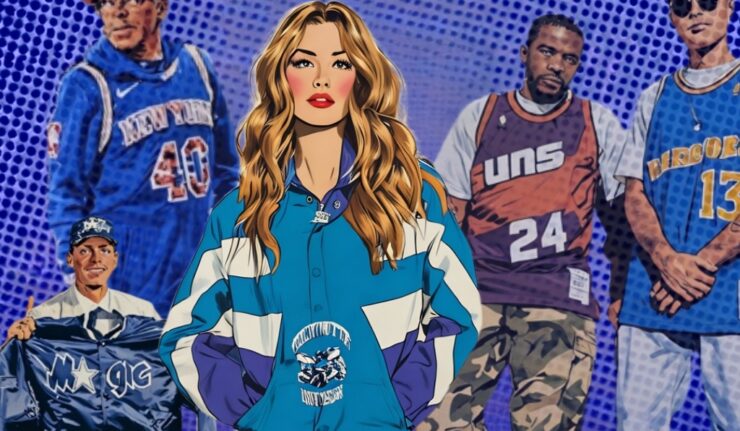
The Starter jacket, in particular, was the crown jewel. It was a satin-finished piece of armor. The “Look for the Star” logo on the sleeve became a badge of authenticity that transcended the sport. If you were wearing a Raiders or a Bulls jacket in 1992, you were broadcasting a specific frequency of cool. It was a look that suggested you were part of the action even if you never touched a rim.
It wasn’t just about the stars, though. It was about the logos. The NBA of the nineties was a masterclass in graphic design. The Phoenix Suns’ “burst” logo, the Orlando Magic’s pinstripes and stars, and the Toronto Raptors’ prehistoric mascot were all designed during a period of maximalism. These weren’t just sports logos; they were wearable pop art. They popped on the grainy television screens of the era and even more so in the saturated colors of high-budget music videos.
Rappers like Tupac Shakur and The Notorious B.I.G. moved between luxury and the local. Biggie might have been wearing a Coogi sweater one day, but the next he was draped in a New York Knicks jersey. This fluidity created a bridge. It suggested that NBA gear was a luxury in its own right—a piece of “street couture” that held as much weight as a Gucci loafer.
The league itself was initially wary of this embrace. There was a tension between the corporate image David Stern wanted to project and the raw, hip-hop-adjacent energy that was actually driving the merchandise sales. This tension eventually culminated in the 2005 dress code, a move seen by many as a direct attempt to distance the league from the very culture that had made its apparel a global phenomenon.
But you cannot put the toothpaste back in the tube. By the time the league tried to mandate business casual, the NBA jersey had already appeared on every major runway and in every major film. It had become a global language. A kid in Tokyo wearing a Michael Jordan jersey wasn’t necessarily a Bulls fan; he was a devotee of the “Air” aesthetic.
“The NBA wasn’t just selling tickets,” one fashion historian observed. “It was selling a lifestyle. And that’s where vintage sportswear found its eternal cool.”
Today, the “tunnel walk” has replaced the pre-game warm-up as the primary fashion event. Players like Russell Westbrook and LeBron James have become the ultimate influencers, reversing the flow of the nineties. Instead of the rappers copying the players, the players are now the ones sitting front row at Paris Fashion Week, often wearing high-fashion reinterpretations of the very gear their predecessors popularized.
The cycle is complete. The satin jacket that used to be a $60 stadium souvenir is now a $3,000 designer collaboration piece. The snapback hat, once a simple tool to block the sun, is now a curated accessory that anchors an entire “fit.”
What remains constant is the power of the logo. Whether it’s the classic Jerry West silhouette or the bold typography of a vintage crewneck, NBA gear remains the most durable currency in the world of streetwear. It is a reminder that the best fashion isn’t created in a vacuum—it’s forged in the heat of the game and the rhythm of the street. It’s about the heart of a champion, but it’s also about the cut of the cloth.


