

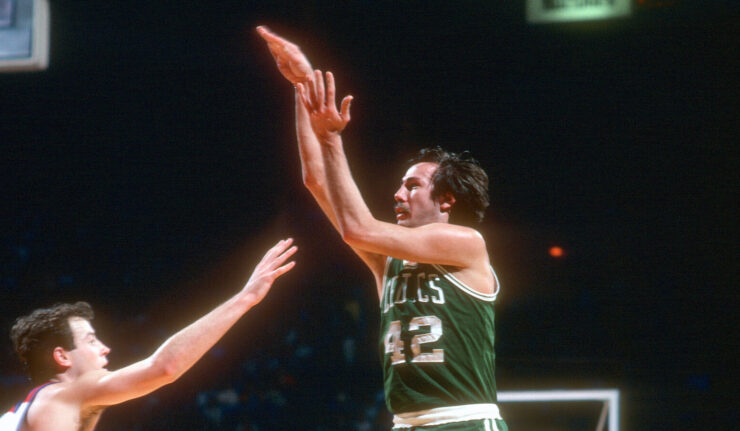
When Chris Ford released that 23-footer on October 12, 1979, nobody in Boston Garden could have predicted he was launching a revolution. Ford’s shot, the first three-pointer in NBA history, landed the same night Larry Bird and Magic Johnson made their professional debuts. The timing was symbolic. Basketball was about to change forever, though it would take decades for anyone to realize it.
The Skeptical Beginning
Basketball three point history starts with resistance. The NBA adopted the line in 1979 after watching the American Basketball Association use it as a marketing gimmick for nearly a decade. Most coaches, players, and executives dismissed it as exactly that. Franklin Mieuli, owner of the Golden State Warriors, called the rule change “immoral” and predicted it would destroy team basketball. Larry Bird’s coach, Red Auerbach, thought it belonged “on the nose of a circus seal.”
The numbers from that first season tell the story of a league that didn’t know what to do with its new toy. Teams averaged 2.8 three-point attempts per game. They made them at a dismal 28% clip. The shot was used almost exclusively as a desperation heave when trailing late, not as a strategic weapon. In the 1980 NBA Finals, Julius Erving made the only three-pointer of the entire series in Game 3. In Game 4, neither team attempted a single shot from beyond the arc.
Basketball was still a big man’s game in 1979. Teams fed the ball inside to centers and power forwards who could score over smaller defenders. The mid-range jumper ruled the perimeter. Taking a shot from 23 feet away when you could take one from 18 feet made no mathematical sense to coaches who’d grown up in a different era.
The Pioneers Who Saw Something Different
But some players understood what others missed. Larry Bird took 143 three-pointers in his rookie season and made 58 of them, good for a 40.6% success rate. That ranked third in the league, remarkable for a forward who could score from anywhere on the floor. Bird didn’t just shoot threes when left open. He took them with hands in his face, fading away, off balance, in crunch time.
Bird’s confidence bordered on arrogance. Before the 1988 Three-Point Contest during All-Star Weekend, he walked into the locker room and asked the other competitors, “Who’s coming in second?” He kept his warmup shirt on during the competition as if the whole thing was beneath him. Then he won, draining 11 straight shots to close out Dale Ellis in the final round. Bird would win the contest three consecutive years from 1986 to 1988, legitimizing the three-pointer among skeptics who still thought it was a gimmick.
Dale Ellis became the first player to make 1,000 career three-pointers, finishing with 1,719 before retiring in 2000. In the 1988-89 season, he shot 47.8% from beyond the arc and made 162 threes total. Michael Adams, a 5-foot-10 point guard, attempted 564 three-pointers in 1990-91, proving smaller players could thrive in a league dominated by giants.
Danny Ainge broke the 100-three barrier in 1988 with 148 makes. Reggie Miller, who entered the league in 1987, would eventually retire as the all-time leader in three-pointers made with 2,560. Miller showed how a shooter could stretch defenses simply by existing on the floor. Teams had to account for him 30 feet from the basket. His movement without the ball, his ability to shoot off screens, and his lightning release made him a nightmare matchup. His eight points in nine seconds against the Knicks in 1995 demonstrated how quickly three-pointers could erase deficits.
The Slow Acceptance
Still, basketball three point history shows that acceptance came grudgingly. Throughout the 1980s, teams averaged fewer than five attempts per game. The shot was viewed as a specialty skill for certain players, not a fundamental part of offensive strategy. In 1982-83, the league shot a collective 23.8% from three, the worst season on record.
Things started shifting in the late 1980s. The 1986 introduction of the Three-Point Contest at All-Star Weekend helped popularize the shot. Young players started practicing three-pointers the way previous generations had practiced hook shots and layups. Attempts climbed from 2.8 per game in 1980 to 6.6 per game by 1989.
The NBA experimented with moving the line closer in 1994, shortening it from 23 feet, 9 inches to 22 feet around most of the arc. Attempts jumped to 15.3 per game. Players shot better percentages from the shorter distance, peaking at around 37% in 1996-97. But when the line returned to its original distance in 1997-98, attempts didn’t drop back down. The genie was out of the bottle.
John Starks became the first player to make 200 three-pointers in a season in 1995. By then, every team had at least one player whose primary job was shooting from distance. The three-point specialist had become a recognized position.
The Analytics Revolution
The early 2000s brought spreadsheets to basketball. Analysts started looking at shot efficiency in ways coaches never had. The math was simple and devastating to traditional thinking: a player who shoots 33% from three scores at the same rate as someone who shoots 50% from two. A 36% three-point shooter is more efficient than most mid-range shooters. Suddenly, the 18-foot jumper that had been a staple of basketball for decades looked like a bad investment.
The 2004-08 Phoenix Suns, led by point guard Steve Nash and coach Mike D’Antoni, pioneered what would become known as “seven seconds or less” basketball. They pushed pace, spread the floor with shooters, and fired up threes early in the shot clock. The strategy worked. They won 54, 62, 61, and 55 games in those four seasons, reaching the Western Conference Finals twice.
Other teams watched and learned, but nobody fully committed. The Suns were considered an outlier, a fun regular season team that couldn’t win championships because they didn’t have enough size or defense. Traditional thinking still held that championships were won in the paint with dominant big men.
The Warriors Change Everything
Basketball three point history has a clear inflection point: Stephen Curry. Drafted seventh overall in 2009, Curry was considered an excellent shooter but too small and fragile to be a franchise player. Scouts worried about his slight frame. Teams passed on him for bigger, more traditional prospects.
By 2012-13, those scouts looked foolish. Curry made 272 three-pointers that season, breaking the record. But it wasn’t just volume. Curry shot 45.3% from three despite taking shots no reasonable person would attempt. He pulled up from 30 feet in transition. He created space with his dribble and fired before defenders could recover. He made threes off the bounce, off screens, in transition, and in isolation. His range extended to the logo at halfcourt.
The Warriors, recognizing they had someone unique, built their entire system around Curry’s shooting. They drafted Klay Thompson in 2011, another elite shooter. They signed Andre Iguodala, traded for Andrew Bogut, and constructed a roster full of players who could space the floor. Draymond Green, their power forward, was a willing three-point shooter despite below-average percentages. The traditional lineup of two guards, two forwards, and a center gave way to positionless basketball with five players who could all pass, dribble, and shoot.
The Warriors attempted 24.1 three-pointers per game in 2012-13. By 2015-16, that number had jumped to 31.6, the most in the league. They won 73 games that season, breaking the record for most regular season wins. Curry won MVP unanimously. The team routinely beat opponents by double digits. They shot 41.6% from three as a team, the best mark in NBA history to that point.
Other teams watched the Warriors win a championship in 2015, nearly repeat in 2016, and win again in 2017 and 2018. The lesson was obvious: you either adapt or you die. The Houston Rockets, under general manager Daryl Morey, took the philosophy even further. In 2018-19, they attempted 45.4 three-pointers per game, an NBA record. They eliminated mid-range shots almost entirely, living by a simple principle: shoot threes or layups, nothing in between.
The Modern NBA Game
By the 2018-19 season, teams averaged 32.0 three-point attempts per game, more than eleven times the rate from 1979-80. Recent seasons have pushed that number even higher. In 2024-25, teams average 37.6 attempts per game. Nearly every position is expected to shoot threes now. Centers who would have been limited to dunks and hook shots twenty years ago are parking themselves beyond the arc. Point guards launch from the logo. Power forwards shoot 35% from three.
Basketball three point history shows a complete transformation in offensive philosophy. Teams don’t just tolerate three-point shots anymore. They design entire systems around maximizing them. Defenses have adapted by switching more aggressively, playing zone concepts, and closing out harder on shooters. The game is faster, more spaced, and higher scoring than ever before.
Some fans argue the revolution has gone too far. When teams combine to attempt 80 three-pointers in a game, it can feel repetitive. The mid-range game that produced legends like Michael Jordan’s fadeaway and Dirk Nowitzki’s one-legged jumper has nearly vanished. Every team plays similarly now, launching threes and attacking the rim while avoiding everything in between.
Others celebrate the evolution. Basketball is more democratic than it ever was. Smaller players can dominate. International players who grew up shooting from distance fit seamlessly into NBA systems. The three-pointer has made comebacks more common and games more unpredictable. A team can erase a 15-point deficit in three minutes with hot shooting.
The Numbers Tell the Story
Consider this trajectory: 2.8 attempts per game in 1979-80. 6.6 attempts by 1989-90. 13.7 attempts by 1999-2000. 22.4 attempts by 2009-10. 32.0 attempts by 2018-19. 37.6 attempts by 2024-25. That’s more than a 1,200% increase in 45 years.
Shooting percentages have held relatively steady since 2000, hovering between 35% and 37%. But players are taking much harder shots now than they did two decades ago. Stephen Curry pulling up from 28 feet off the dribble is a routine play in 2025. In 1995, it would have gotten a player benched.
Curry himself has made 4,032 career three-pointers, 857 more than any other player in history. He passed Ray Allen’s record in 2021 and hasn’t slowed down. James Harden, Damian Lillard, and other modern players regularly launch from distances that would have been considered desperate heaves a generation ago.
What Changed after the 3-Point Shot
Basketball three point history isn’t just about one rule change. It’s about how players, coaches, and executives gradually recognized the mathematical advantage of efficient three-point shooting. It’s about Larry Bird, Dale Ellis, and Reggie Miller proving the shot was more than a gimmick. It’s about analytics teams calculating expected value and finding that three is bigger than two. It’s about Stephen Curry showing that range has no limits for a truly elite shooter.
The game Chris Ford played in 1979 would be almost unrecognizable to modern players. Teams shot more than 60% of their attempts inside the paint. The pace was slower. Possessions lasted longer. Coaches ran set plays through post players who backed down defenders and took jump hooks from eight feet.
Now, teams play five-out offense with all five players capable of shooting from distance. Possessions end in seven seconds. Centers set screens 25 feet from the basket and pop for threes. Forwards handle the ball like guards. The paint is often empty except for drives to the rim.
Some rule changes revolutionize sports immediately. Others take decades to fully materialize. The three-point line fell into the second category. It took 40 years for basketball to fully embrace what Abe Saperstein, the founder of the Harlem Globetrotters and the American Basketball League, envisioned in 1961 when he first drew the arc: a game where smaller players could compete with giants, where skill mattered as much as size, where every possession carried the threat of explosive scoring.
Ford’s shot in 1979 was just the beginning. The revolution is still ongoing.