
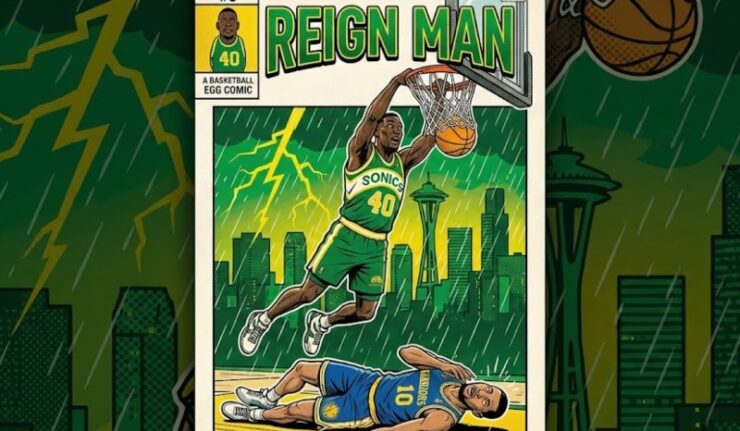
If Isaac Newton had watched Shawn Kemp play basketball, he might have revised his laws of motion to include a special clause for “force applied with absolute malice.” Shawn Kemp didn’t just dunk the basketball; he treated the rim like it owed him money and the defender like a witness who knew too much.
In the pristine, analytically-driven NBA of the 2020s, “vertical spacing” is a polite term for having a guy who can catch lobs. But in the 1990s, the paint was a dark alley where fouls were essentially assault and battery charges that referees ignored if you didn’t bleed. This was the era of the clothesline, the hip-check, and the “no layups” rule. Into this grinder walked Shawn Kemp, a man-child with the athleticism of a leopard and the temperament of a stick of dynamite.
Kemp’s career is often remembered as a tragedy of unfulfilled potential—a “what if” story involving weight gain and lost explosiveness. But that ignores the sheer, terrifying reality of his prime. For a solid six-year stretch with the Seattle SuperSonics, Kemp was arguably the most exciting player on the planet not named Michael Jordan. He wasn’t technically polished in the way Tim Duncan was; he didn’t have Hakeem Olajuwon’s footwork. What he had was a raw, kinetic fury. When Gary Payton threw a lob—often to a spot that seemed mathematically impossible to reach—Kemp would materialize out of the rafters, snatch the ball, and detonate.
The “Lister Blister” remains the Mona Lisa of disrespect. In the 1992 playoffs, Kemp caught the ball, drove the lane, and dunked on Golden State’s Alton Lister with such violence that it looked like a personal vendetta. But the dunk wasn’t even the best part. It was the landing. Kemp landed, crouched, and pointed two fingers at the fallen Lister while yelling. In today’s NBA, that taunt gets you a technical foul, a suspension, and a sensitivity training seminar. In 1992, it just got you on a poster on every bedroom wall in Washington state.
Kemp’s athleticism was uniquely suited for the 90s physical grinder. Modern players are often “long” and “fluid.” Kemp was thick and explosive. He played in an era where power forwards were 260-pound bouncers like Charles Oakley and Karl Malone. Kemp had to absorb blows that would hospitalize a modern stretch-four, yet he still finished through contact with acrobatic grace. He was a Ferrari engine inside a tank. If he played today, with the floor spaced and defenders terrified to touch him, he might average 35 points on dunks alone.
He was “The Reign Man,” a nickname that worked on every level—he reigned over the rim, and he made it rain terror on anyone foolish enough to jump with him.
Critically, his career fell off a cliff the moment he left Seattle. The lockout-shortened 1999 season saw him arrive in Cleveland looking less like the Reign Man and more like the “Rain Delay.” The explosiveness waned, and without that supernatural lift, his game suffered. He became a cautionary tale of conditioning and discipline.
However, we shouldn’t let the sad ending obscure the thrilling middle. Shawn Kemp was the id of the NBA. He played with a joy and aggression that was infectious. He proved that you didn’t need a reliable three-point shot if you could simply jump over the people trying to stop you. He remains the gold standard for “violent” basketball—a reminder of a time when the highlight reel wasn’t just about skill, but about dominance.